Every spring, thousands of Toronto homeowners climb ladders to clean their windows. Most come back down safely. Some don't. This guide isn't a scare tactic — it's the honest safety information every homeowner should know before deciding to DIY or hire a professional.
The Real Risk: Falls from Height
Window cleaning injuries aren't from the cleaning — they're from the climbing. The data is sobering:
- 42,000+ Canadians injured in ladder falls annually (CIHI)
- 20% of all fall-related ER visits in Ontario involve ladders
- 2 metres (6.5 feet) — falls from this height cause 10% of all traumatic brain injuries
- $2,000-$50,000+ — ER visit cost range for fall injuries
- 300+ Canadians die from falls each year — ladders are the #1 cause of fall deaths at home
For context: a standard first-floor window puts you at ~3 metres (10 feet) on a ladder. A second-floor window: 5-6 metres (16-20 feet). At that height, a fall onto a concrete driveway or patio is potentially fatal.
The DIY Safety Decision Matrix

| Window Location | DIY Safe? | Method | Risk Level |
|---|---|---|---|
| Ground floor, flat ground | ✅ Yes | Squeegee from ground or step stool | Low |
| Ground floor, uneven ground | ⚠️ Caution | Squeegee only, no ladder | Medium |
| 2nd floor, safe ladder placement | ❌ Not recommended | Hire a pro or use extension pole | High |
| 2nd floor, over deck/stairs/slope | ❌ Never | Professional only | Very High |
| 3rd floor+ | ❌ Never | Professional water-fed pole | Extreme |
| Skylights | ❌ Never | Professional only | Extreme |
| Near power lines | ❌ Never | Professional only (ESA regulations) | Life-threatening |
Safe DIY: Ground-Floor Windows Only
If you're cleaning ground-floor windows yourself, follow these safety rules:
Equipment Checklist
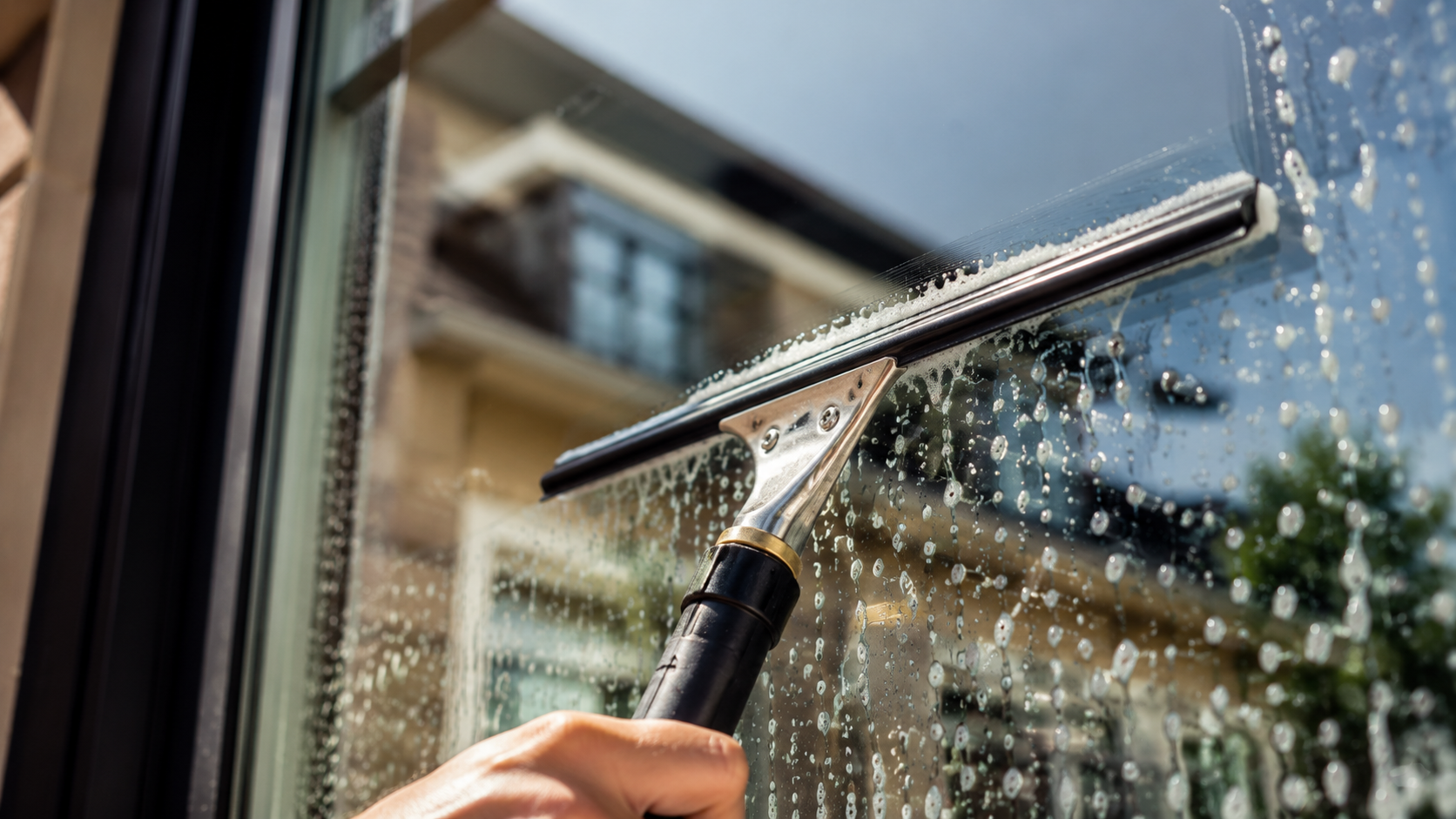
- Squeegee (12" or 14") — not paper towels or newspaper
- T-bar applicator with microfibre sleeve
- Bucket with a few drops of dish soap in warm water
- Microfibre cloths for edges and detail
- Drop cloths if cleaning above flooring you care about
- Step stool (not a ladder) for slightly elevated windows — max 2 steps
Safety Rules
- Never lean. If you can't reach it flat-footed or from a step stool, stop.
- Dry surfaces first. Wet driveways and patios are fall hazards — squeegee or towel the ground.
- No chairs, tables, or improvised platforms. Furniture isn't designed for standing.
- Check glass condition. Tap gently — if it rattles, it's loose. Don't apply pressure to loose panes.
- Avoid chemicals near plants/pets. Use pure water + dish soap. Ammonia kills plants.
- Work in pairs. If you're on a step stool, have someone nearby.
- Skip on windy days. Wind gusts destabilize ladders and blow cleaning solution.
Chemical Safety
| Chemical | Risk | Never Use On |
|---|---|---|
| Ammonia (Windex) | Eye/lung irritation, kills plants | Tinted windows, near gardens |
| Bleach | Burns skin, destroys seals | Painted frames, rubber seals, near plants |
| Vinegar (acetic acid) | Mild — safest DIY option | Marble/limestone sills, natural stone |
| Acid-based cleaners | Etches glass permanently | Low-E coated glass, heritage glass |
| Abrasive cleaners (Comet) | Scratches permanently | ALL glass — never use abrasives |
| Purified water (0 TDS) | Zero risk — pH neutral | Safe for everything |
Toronto-Specific Safety Considerations
1. Ice and Frost (October-April)
Toronto's 80+ freeze-thaw cycles per winter mean ice can form on walkways, driveways, and ladder-placement surfaces without being visible (black ice). Never use a ladder on a surface that might be icy — even if it looks dry.
2. Power Lines
Toronto's residential areas have extensive overhead power lines. The Electrical Safety Authority (ESA) requires a minimum 3-metre (10-foot) clearance from power lines. A metal ladder or wet extension pole near a power line is potentially fatal. If ANY window is within 3 metres of a power line: do not attempt DIY.
3. Construction Zones
With 200+ construction cranes in Toronto, many neighbourhoods have construction debris including alkaline concrete dust (pH 12-13). This dust is caustic — wear gloves and eye protection if cleaning windows in active construction zones.
4. Heritage Windows
Homes in Rosedale, Cabbagetown, The Annex, and other heritage districts may have original wavy glass, leaded windows, or single-pane glass that's more fragile than modern tempered glass. Apply zero pressure — if the glass flexes when you touch it, stop and call a professional.
How Professionals Eliminate Risk
Professional window cleaners don't use ladders for most residential work. Here's what we use instead:
Water-Fed Pole System
- Telescoping carbon fibre poles reach 3-4 storeys from the ground
- Purified water flows through the pole to a soft brush head
- Operator stays on the ground at all times
- No ladder, no climbing, no fall risk
- Reaches windows over decks, slopes, and gardens that ladders can't safely access
ClearCoat™ Purified Water
- 0 mg/L TDS — zero dissolved minerals
- pH 7.0 — completely neutral (safe for all glass, seals, frames)
- No chemicals — safe for plants, pets, children's play areas
- Dries invisible — no streaks, no spots, no residue
When to Absolutely Call a Professional
- Any window above ground floor — no exceptions
- Windows over stairs, decks, or slopes — ladder placement is impossible
- Hard water stains — require professional-grade treatment
- Heritage glass — one wrong move = $1,500-$5,000/window
- Skylights — roof work requires harness systems
- Near power lines — ESA 3-metre clearance requirement
- Storm windows — require removal, cleaning, and reinstallation
- Post-construction — alkaline dust requires specific treatment
- You're over 55 — fall injury severity increases dramatically with age
- You're alone — no one to call for help if something goes wrong
Stay on the Ground. We'll Handle the Heights.
ClearCoat™ purified water. Water-fed poles. No ladders on your property. No risk to you.
Get Free Estimate →